FastAPI CI/CD Lab — Containerized API & Deployment Pipeline
Reproducible FastAPI backend, multi-stage Docker builds, PostgreSQL integration, and hardened GitHub Actions.
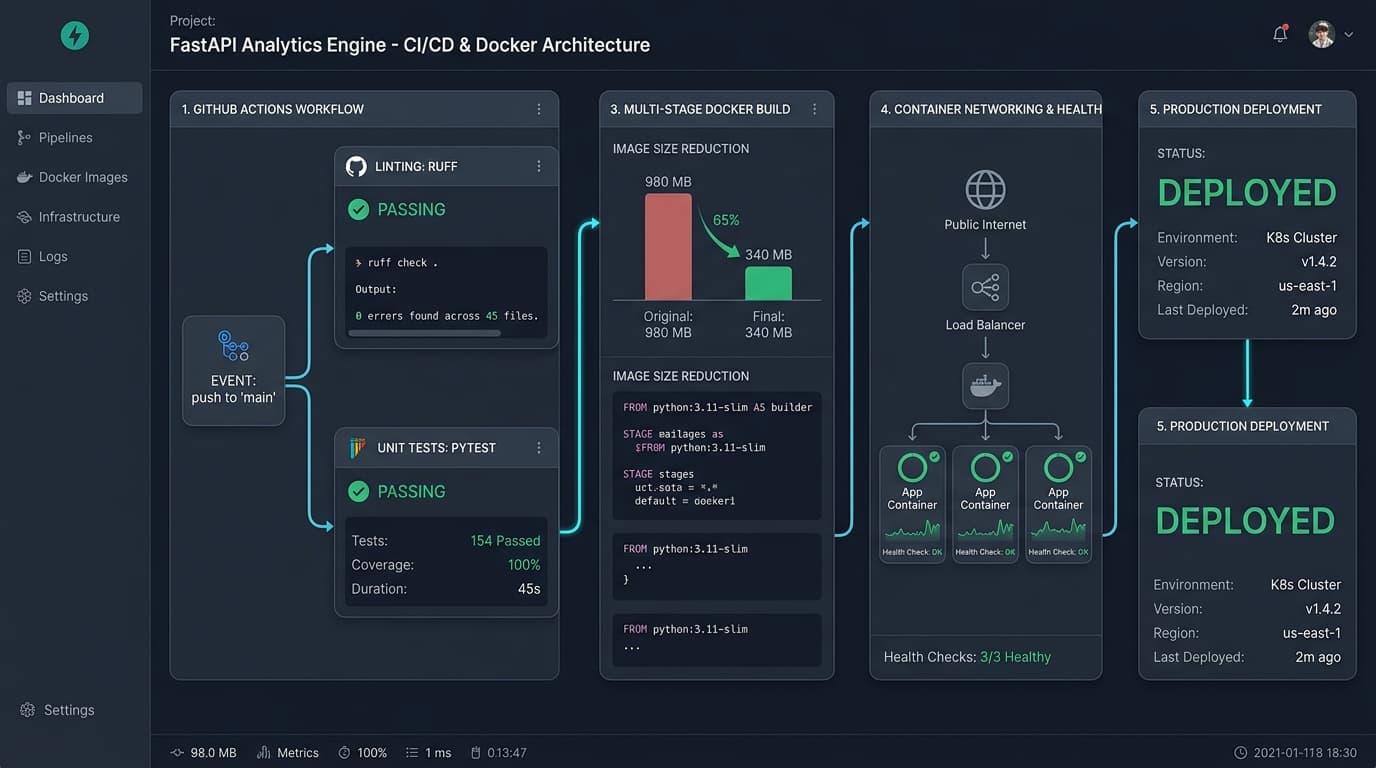
Problem Statement
Backend microservices frequently break during deployment due to mismatched Python environments, slow un-cached Docker builds, and unverified database migrations in CI.
Engineering Goals
- Achieve sub-90-second CI run times using Ruff and cached Docker layers.
- Ensure parity between local development and cloud container execution.
- Validate PostgreSQL database connectivity and migrations inside ephemeral CI runners.
Execution Pipeline & Mechanics
Lint & Format Check
Ruff validates code style and checks for common Python antipatterns in <1s.
Automated Testing
pytest executes API endpoint tests with an ephemeral PostgreSQL service container.
Multi-Stage Docker Build
Constructs a minimal production image, minimizing attack surface and image size.
Container Health Verification
Spins up the built container to verify `/health` endpoint response before publishing.
Engineering Challenges & Design Decisions
Decision: Ruff over Flake8 + Black + isort
Rationale: Ruff is 10-100x faster than traditional Python linters, drastically accelerating CI feedback loops.
Alternative Rejected: Flake8 + Black combination.
Core Architectural Highlights
The repository uses GitHub Actions to orchestrate linting, unit tests, Docker builds, and container verification. A multi-stage Dockerfile produces slim production images by separating build dependencies from the final runtime image.
Testing & Empirical Evaluation
Full test matrix running across Python 3.11 and 3.12 with mock external services.
Security & Reliability Defenses
Key Engineering Learnings
- •Designing test suites around ephemeral PostgreSQL containers catches real-world SQL constraint errors that sqlite in-memory mocks hide.